Movies. Most people love them. There is a reason that they
are one of the top forms of entertainment in our world. We love to watch
movies, but do we love to go to the
movies? Actually going out to the movie theater is not as popular as it
once was, but it is still a common and relatable form of entertainment. Talking
to my grandma about movies was the most fun interview so far, and I learned a
lot about her experiences and our family.
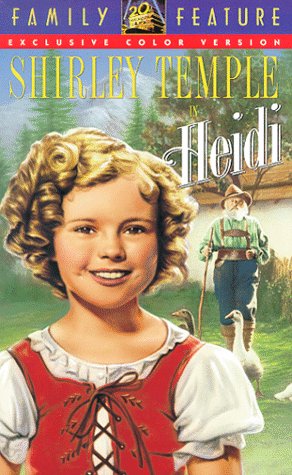 |
Heidi starring Shirley Temple, 1937
© imbd.com
|
Grandma did not remember many details about the movie theater, so I reached out to two of her siblings to see what they could remember, and they shared some of their memories with me. The Rex theater, as it was called, was an old building that was rumored to be an old horse barn, so it was sometimes called “Dan’s Horse Barn.” The first ten rows of the theater were wooden benches, and unaccompanied children had to sit there, as opposed to the cushioned seats in the back. Of course, kids often tried to sneak back to the better seats, but the theater owner would routinely check them and send the kids back to the front. Kids would go to the grocery store next to the theater to buy their candy to take in with them. Friday night was the most popular night for kids to go because they could usually see cowboy movies, with actors like Roy Rogers and Gene Autry.
  |
Left: Roy Rogers and Mary Hart in Shine on Harvest Moon, 1938
https://upload.wikimedia.org/wikipedia/commons/0/01/Roy_Rogers_-_Hart_-_1938.jpg
Right: Gene Autry, 1950
https://upload.wikimedia.org/wikipedia/commons/d/d4/Gene_Autry_1950.jpg
|
Movies directed more towards adults were shown on Sundays,
with a higher price. Apparently, the theater would change its film three times
a week, so one would be shown on Sunday and Monday, and then a different one
would be shown through the week with a new one coming in for the weekend. The
“better” movies were shown on Sundays and Mondays. Also, it would typically
screen the movie twice in one night, and customers could stay for both showings
if they wanted. One interesting observation from my uncle was that “movies back
then had to have some singing in them, even when it didn’t even fit into any
plot.” We do not see much singing in movies today, besides an occasional
musical, so that might reflect the changing interests of audiences. There was
never a movie that Grandma’s parents would not allow the kids to see, but the
theater owner would not have shown anything that was not kid-friendly. Grandma
remembered the cashier at the theater letting them in for free sometimes, but
her sister remembers a different way of getting tickets. According to her, a
friend’s mother collected tickets and would pass them out to the kids so they
could get in for free.
 |
The Ironwood Theatre today
http://cinematreasures.org/theaters/2761/photos/108209
© cinematreasures.org user Jasperdo
|
There was another theater in nearby Ironwood, which still
hosts events today as a historic landmark, but Grandma said that she did not go
to that one often because it was farther away. However, according to her
younger brother, their father would sometimes take them to Sunday matinees
there as a treat. They would ride the bus the seven miles there and back. Interestingly,
neither Grandma nor her siblings could remember their mother ever going out to
a movie.
 |
The Esquire Theatre at night, 1938
http://cinematreasures.org/theaters/256/photos/151290
© cinematreasures.org user Comfortably Cool
|
 |
The Little Gallery area of the Esquire Theatre, 1941
http://cinematreasures.org/theaters/256/photos/176698
© cinematreasures.org user dallasmovietheaters
|
After moving to Chicago in the 1940’s, Grandma still liked
to go to the movies. She remembers “the nice theater around the block,” called
The Esquire, that she would attend with her sisters and roommates. After she
met my grandpa, they would go there on dates. Drive-In theaters were also a
popular attraction. They went sometimes in Chicago, and continued to go after
they got married and moved to Missouri. They would take their 1934 Ford and
cruise to the Highway 50 Drive-In during the late 1940s and 1950s. The drive-in
had stations with speakers that visitors would hang on their car windows, and
ramps to elevate the car. It
also had a concession stand in the middle of the lot and it featured a
playground for kids. Unfortunately, it was destroyed by a tornado in 1980, but a
new multiplex theater was built in its place.
After their kids were born, Grandma and Grandpa did not go
out to movies as often. Grandma remembers taking my mom and uncles to the
drive-in when they were little, even though they do not remember it well. In
addition to the drive-in, there were two indoor theaters in town, the Uptown
and the Fox. They frequented the Fox more often, because it was “more modern,”
and had “better shows.” It also featured serial movies, which would come out on Saturday nights, so it was the popular place to be. The Uptown and the Fox were where my parents, aunts, and uncles saw many movies throughout their youth.
 |
Ad for the grand opening of the Hi-Way 50 Drive-In, Sedalia, MO, 1949
http://cinematreasures.org/theaters/37052/photos/12474
© cinematreasures.org user dallasmovietheaters
|
Grandma did not mention many specific favorite movies, but
Grandpa, who was listening in, was quick to chime in with his love for
Westerns. Luckily for him, Westerns were very popular in the theaters, so he
was rarely disappointed. One popular actor of the time they did not care for
was Elvis Presley. Grandpa said, “He didn’t go over very big here.” Needless to
say, they did not go see many of his movies. However, they did go to see reruns
of older movies, like Gone with the Wind
and The Wizard of Oz when the
theaters would screen them.
Grandma reiterated a few times that she and her friends went
to movies because there was not anything else to do in their town. I relate to
that because that is how my friends and I feel now. Seeing a movie is always
our standby when there is not anything else going on. It is an easy way to
spend time together and share an experience as a group.
These days, movies are not a big part of my grandparents’
lives. The last movie they remember going to the theater to see was Pearl Harbor, which came out in 2001.
They watch movies on TV occasionally, but they usually prefer regular TV
programs. They never rented or bought movies, and I do not think they ever had
any kind of video player. Movies went from being one of their go-to pastimes to
just something that they used to do.
Movie theater attendance may be lower than in the past, but
we still love movies. Streaming services like Hulu and Netflix are part of our
culture, and they will continue to play a huge part in our entertainment in the
future. Movies are how we pass many nights with friends and family. Our
favorite movies say something about us, which is why when we get to know
someone we often share our favorite movies. Movies can be the common ground we
find with new friends. They are how we escape our own world for a couple of
hours and enter one that is more exciting, more dangerous, more outrageous.
People have been searching for this escape since the days of the “peep show”
galleries in the late nineteenth century. Today, we regularly see
multimillion-dollar blockbusters that attempt to create unique,
larger-than-life viewing experiences. While much has changed about movies over
the years, our reasons for seeing them are largely the same. That just shows
that my generation is not so different from our grandparents after all.


